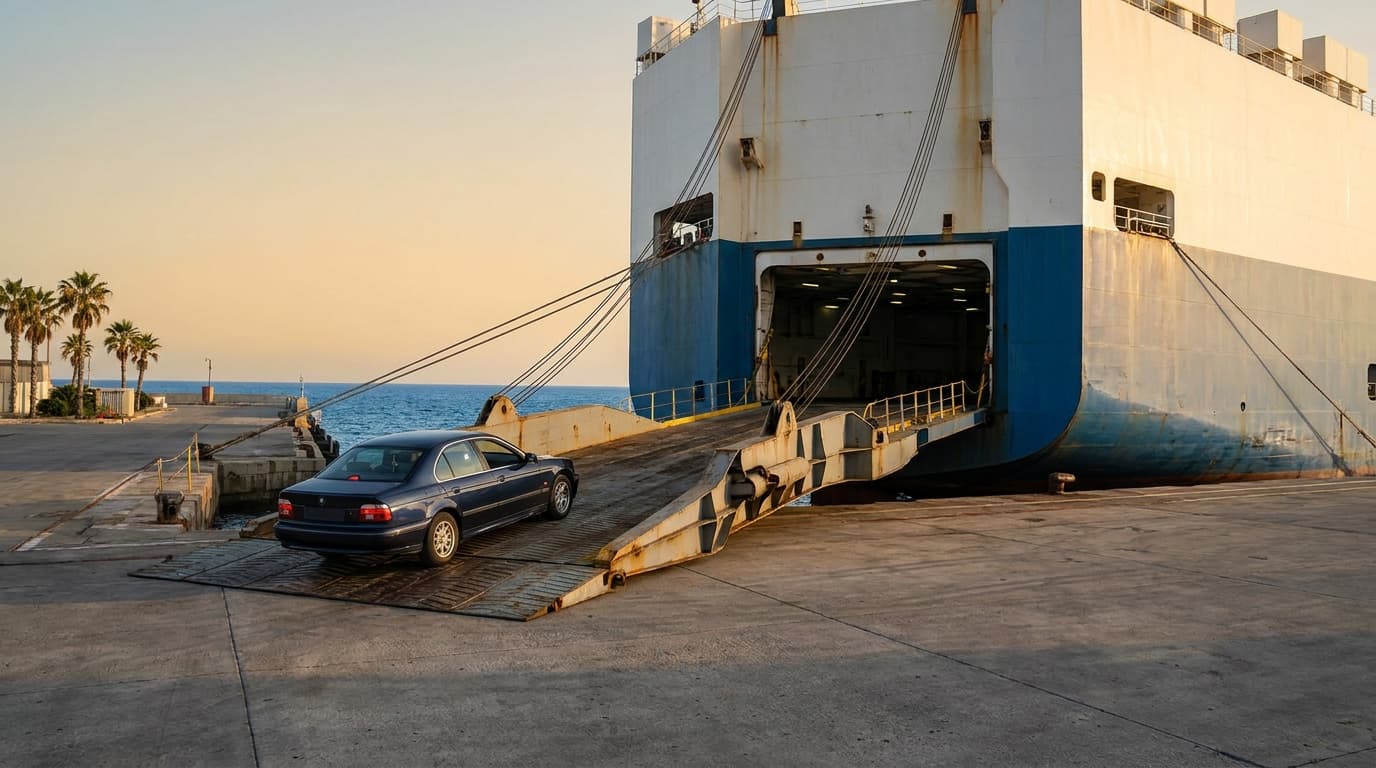
The short answer is no. To ship a non-running car to Hawaii through Car Shipping Hawaii's standard service, the vehicle must be repaired first. Matson, the ocean carrier, requires every car to operate under its own power at the Port, and that requirement is not negotiable on the standard vehicle decks.
This leaves owners of disabled vehicles with a practical question: what counts as "running" versus "non-running," and where is the line? A car that seems fine in a driveway can still be refused at the gate if it fails the specific requirements Matson enforces.
What "Running" Actually Means When You Ship a Non-Running Car to Hawaii
Matson's published vehicle preparation rules require the car to move under its own power. That means the engine must start, the transmission must engage, the steering must function, and the brakes must work. The vehicle also needs a working emergency brake.
A car with a dead battery that cannot be jumped is non-running. A car with seized brakes is non-running. A transmission stuck in park or neutral, unable to shift, makes the vehicle non-running. If Port staff cannot drive the car onto the vessel, the car does not ship.
The fuel requirement adds another layer. Matson specifies fuel above one-eighth tank and below one-quarter tank. The car cannot arrive empty, because Port workers need to drive it. "Ran out of gas on the way" is not the same as a mechanical failure, but arriving with an empty tank still blocks loading until the problem is solved, and the Port is not a gas station.
Cosmetic Problems Versus Mechanical Failures
A car with dents, scratches, or faded paint is not disqualified. Surface damage is irrelevant to the running requirement. The same goes for worn interiors, missing trim pieces, or non-functional accessories like a broken radio or stuck window.
Where the line changes is warning lights. Matson's rules are explicit: any check-engine, airbag, or tire warning light means the vehicle is refused. A car might drive perfectly well with that orange check-engine glow, but Matson will not load it. This catches owners off guard when they assume a running car is automatically an acceptable car.
Ground clearance matters as well. Matson requires at least six inches of clearance. A lowered car, one with worn suspension, or a vehicle sitting on a flat tire may fail this requirement even though the engine runs fine. Measure before you drive to the Port.
Why the Standard Route Cannot Handle Non-Running Vehicles
The standard service through Car Shipping Hawaii uses Matson's roll-on, roll-off decks. Vehicles drive aboard under their own power and drive off at the destination. There is no crane lifting cars into containers, no forklift sliding them into place. The infrastructure assumes every vehicle can move.
This is not a policy Car Shipping Hawaii invented. It is how the ocean carrier operates. Matson's crew does not have the equipment or the process to handle a dead vehicle on the standard auto decks. A non-running car would block the line, delay other vehicles, and create safety problems during the voyage.
Car Shipping Hawaii does not broker forklift loading, container stuffing, or any workaround for disabled vehicles. If a car cannot roll, the standard service is not available. The company ships standard personal vehicles only: cars, SUVs, pickups, and vans that meet the running requirement. Motorcycles, RVs, trailers, boats, and oversized vehicles are not shipped.
What to Do If Your Car Cannot Run Right Now
Repair it before booking. That advice sounds obvious, but many people call hoping for an exception or a special arrangement. There is none on the standard route.
A dead battery is often the simplest fix. A new battery or a jump pack that holds a charge long enough to get the car to the Port solves the problem. A seized brake caliper or a failed starter motor takes more work, but the repair still costs less than the complications of arriving at Long Beach Port or Oakland Port with a car that will not move.
If the car needs significant mechanical work, handle it on the mainland before shipping. Labor rates, parts availability, and shop options are generally better in California than on the islands. Shipping a broken car, if it were even possible, just moves the problem to a place where fixing it costs more.
For vehicles in questionable mechanical condition, or non-plug-in hybrids where the battery system needs verification, confirm eligibility at booking. The step-by-step process explains what happens after you request a quote, including the vehicle information Car Shipping Hawaii collects to confirm the car qualifies.
Electric Vehicles and Plug-In Hybrids Are Also Excluded
The running requirement is not the only restriction. Battery-electric vehicles and plug-in hybrids are not accepted on the Matson service Car Shipping Hawaii sells. Carrier safety rules for lithium battery systems exclude these vehicles from the standard auto decks entirely.
Regular non-plug-in hybrids require exact year, make, model, and battery-system verification before Matson acceptance can be confirmed. Some older hybrids with nickel-metal hydride batteries may qualify; some newer ones with lithium components will not. The only way to know is to provide the vehicle details at booking and wait for confirmation.
This is separate from the running question, but it catches people off guard. A perfectly operational Tesla or Chevy Bolt cannot ship through this service regardless of how well it drives.
How Car Shipping Hawaii Confirms Vehicle Eligibility
When a customer requests a quote, the vehicle information goes through a qualification check. Year, make, model, and dimensions determine whether the car fits the size limits. Long Beach Port accepts vehicles up to 260 inches long, 96 inches wide, and 84 inches high. Oakland Port has stricter requirements: 76 inches high including roof racks or roof carriers, and 76 inches wide measured from outside tire to outside tire. A vehicle that fails Oakland but fits Long Beach can ship from Long Beach Port.
The powertrain type determines whether it falls into the EV or plug-in exclusion. If everything checks out, the quote reflects the cost to ship a standard personal vehicle on the route. If something is uncertain, like a hybrid's battery system, the team confirms with Matson before the booking is finalized.
For a straightforward running vehicle, the free instant quote gives a price in seconds. For anything unusual, a conversation clarifies whether the car qualifies before any money changes hands.
Preparation Matters Even for a Running Car
A car that runs can still be refused if it arrives dirty, loaded with personal items, or with warning lights illuminated. Matson's published vehicle preparation rules require a clean exterior, a vacuumed and dry interior, and removal of all personal belongings except up to two child car seats and factory-installed accessories.
The USDA agricultural inspection checks wheel wells, undercarriage, and interior for mud, dirt, grass, seeds, and pet hair. A car that fails is not shipped until cleaned at the owner's expense and re-inspected. This applies at origin and destination.
Alarms must be disengaged. Fire extinguishers must be removed (federal regulation). Toll tags, loose electronics, bike racks, non-factory roof racks, and any ignition interlock device all need to come out. The complete drop-off day guide covers every step.
Frequently Asked Questions
Can a car with a check-engine light ship to Hawaii? No. Matson refuses any vehicle with a check-engine, airbag, or tire warning light illuminated. The car must pass a condition survey at the Port, and warning lights are automatic disqualifiers regardless of how well the car otherwise runs.
What if my car runs but has cosmetic damage? Cosmetic damage does not affect eligibility. Dents, scratches, faded paint, and worn interiors are fine. The vehicle just needs to operate under its own power, meet the clearance requirement, and pass the cleanliness inspection.
Can I ship a car that needs a jump start? A car that starts with a jump is technically running, but it must hold enough charge to drive onto the vessel and off again at the destination. If the battery dies the moment cables are removed, the car is effectively non-running. Replace the battery before drop-off.
Does Car Shipping Hawaii offer any service for non-running vehicles? No. The standard service through Matson requires every vehicle to move under its own power. Car Shipping Hawaii does not broker forklift loading, container shipping, or any alternative handling for disabled vehicles.
What happens if my car is refused at the Port? The car stays with you, and you need to resolve whatever issue caused the refusal. This could mean a tow home, an on-the-spot repair if possible, or missing the sailing and rebooking once the car is fixed. Arriving with a vehicle that cannot be accepted often means unexpected expenses. The 7 mistakes to avoid when shipping a car to Hawaii covers this scenario and others.
Shipping a car to Hawaii through the standard route requires a vehicle that drives, steers, brakes, and passes inspection. If your car meets those requirements, getting a price takes less than a minute. Visit carshippinghawaii.com for a free instant quote and confirm your vehicle qualifies before you plan the rest of your move.
About Car Shipping Hawaii: Car Shipping Hawaii is a vehicle transportation broker operating since 2006, arranging door-to-port and port-to-port vehicle shipping between the US mainland and the Hawaiian Islands. Instant online quotes available at carshippinghawaii.com.