San Diego to Honolulu is one of our most straightforward routes and, for the right customer, one of the few where skipping the overland carrier entirely is a genuinely practical option. The Port of Long Beach is 115 miles up I-5 from downtown San Diego. Customers who want to save the carrier cost can drive their vehicle to Long Beach in under two hours and drop it themselves. That option is worth knowing about before you book. This guide covers when it makes sense, what the route looks like either way, and the military PCS details that matter for a city with the highest concentration of Hawaii-bound PCS moves in the continental United States. This guide covers everything specific to shipping a car from San Diego to Hawaii, including Long Beach port routing, the port-to-port option for San Diego customers, carrier pickup logistics near military installations, vehicle preparation, and the full all-in cost from a San Diego address.
How the San Diego to Honolulu Route Works
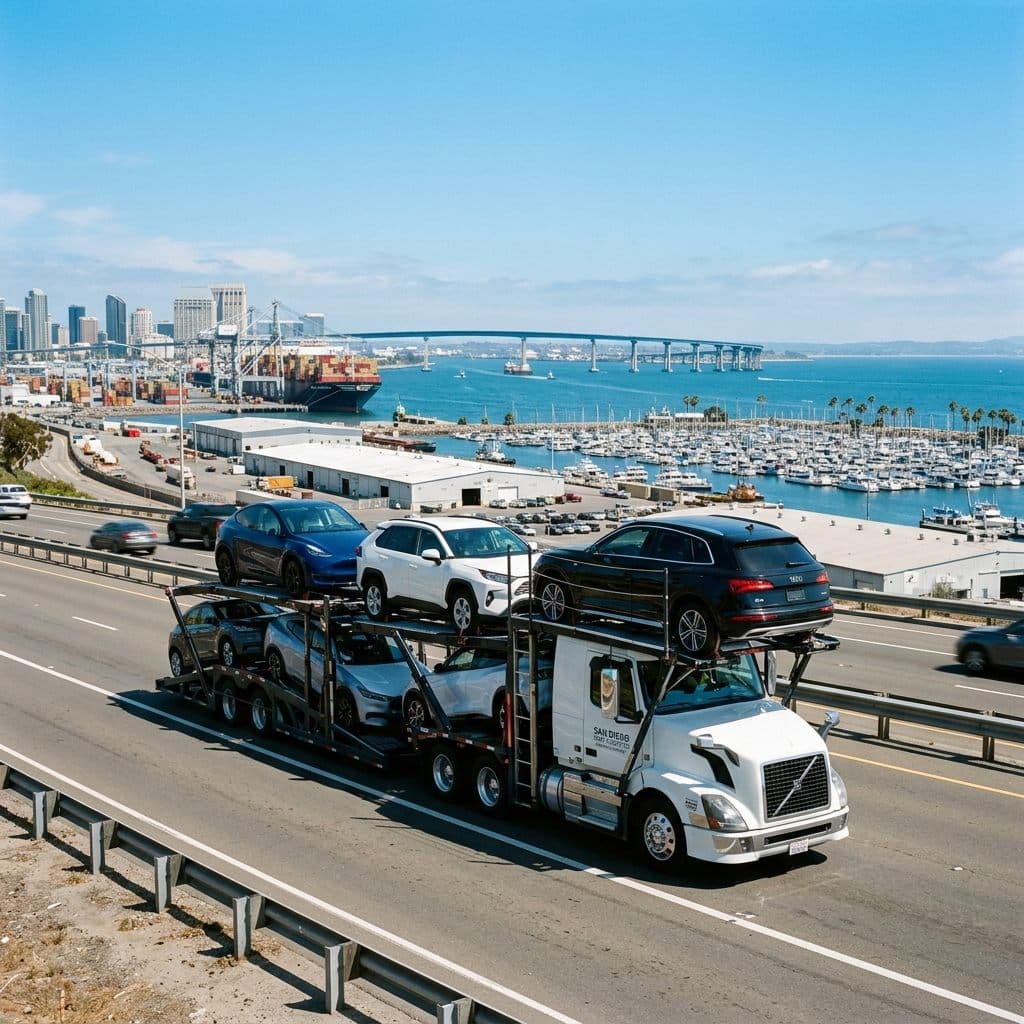
Every vehicle shipping from San Diego to Honolulu travels via two legs. The first leg is overland, where a licensed carrier picks up your vehicle in the San Diego area and transports it north on I-5 to the Port of Long Beach. The second leg is ocean freight, where your vehicle loads onto an enclosed Matson Roll-on/Roll-off vessel at Long Beach and crosses the Pacific to Honolulu's Sand Island terminal. San Diego routes through Long Beach. Long Beach is the primary departure port for Southern California, the Southwest, Midwest, South, and East Coast. Oakland serves Northern California and the Pacific Northwest. At 115 miles from downtown San Diego, Long Beach is close enough that San Diego is the most practical city in the country for a port-to-port booking, where you drive the vehicle to the port yourself rather than paying for an overland carrier. The Long Beach port has a height clearance of 7 feet and a width clearance of 7 feet 2 inches, measured on the fully assembled vehicle including roof racks, cargo carriers, and extended mirrors. Our team confirms clearance on every booking call. Once your vehicle clears terminal intake at Long Beach, it loads onto the Matson vessel for the ocean crossing. Matson's enclosed RoRo vessels protect your vehicle from saltwater and weather for the entire Pacific transit. Your vehicle drives on at Long Beach and drives off in Honolulu.
Port-to-Port vs Door-to-Port for San Diego Customers
San Diego is the only city in the Tier 1 list where we proactively discuss port-to-port as a serious alternative for a large share of customers. The distance from San Diego to Long Beach is short enough that driving the vehicle yourself is a realistic option, not just a technicality. Port-to-port means you drive your vehicle to the Long Beach terminal yourself and drop it off before the vessel cutoff. The standard booking fee is $150 for port-to-port or $500 for door service, included in your total. K’AI self-service fees are $100 and $300 respectively. The ocean freight rate is identical. If you live in San Diego and can spare a morning to drive to Long Beach, you save the overland carrier cost entirely. Our team walks through this on every San Diego call so the customer can make an informed decision, not just default to door-to-port because it is the first option listed. Door-to-port still makes more sense for customers with scheduling constraints, vehicles that cannot be easily driven to Long Beach, or customers who live farther from I-5 in East County or South Bay. The carrier picks up your vehicle from your address, coordinates the Long Beach cutoff timing, and delivers to the terminal on your behalf.
Total Transit Time: San Diego to Honolulu
Plan for 14 to 17 days total from San Diego door to Honolulu port pickup. That breaks down as follows: same day to 1 day for the overland carrier leg from San Diego to Long Beach, 1 to 2 days for port intake and vessel loading, and 12 to 14 days for ocean transit to Honolulu. After the vessel docks at Sand Island, allow 1 to 2 business days for agricultural inspection clearance before your vehicle is ready for pickup. For port-to-port customers who drive to Long Beach themselves, the overland leg is eliminated entirely. You drop the vehicle at the terminal on the day you choose, and the clock starts at port intake. San Diego port-to-port customers have the tightest and most predictable total timeline of any city we ship from. You can monitor your vessel after it departs Long Beach using the Matson vessel tracking page.
Carrier Pickup Near San Diego Military Installations
San Diego has more military installations generating Hawaii-bound PCS moves than any other city in the continental United States. MCAS Miramar, Naval Base San Diego, Naval Base Coronado, Camp Pendleton, and 32nd Street Naval Station all generate PCS moves to Hawaii with a volume and consistency that makes summer carrier demand in San Diego one of the most predictable surges we see on the entire West Coast. Coronado and the areas immediately adjacent to the naval installations have street access limitations for large car haulers. Residential streets near base housing and the narrower streets on Coronado Island itself can restrict which carrier equipment works for a residential pickup. Our team asks about proximity to the base and street access on every San Diego booking near an installation. Customers in base housing or restricted-access areas may need to stage the pickup at a nearby commercial lot. We coordinate this at booking rather than discovering it on pickup day. Summer PCS season in San Diego, June through August, creates carrier demand spikes that tighten pickup windows across the entire Southern California corridor. Our team starts carrier outreach 3 to 4 weeks ahead on summer San Diego bookings for exactly this reason. A booking placed 2 weeks out in July from a Camp Pendleton address carries meaningful risk of a carrier assignment delay that could push the sailing. We tell customers this upfront.
What Your Vehicle Needs Before Leaving San Diego
Vehicle preparation for Hawaii shipping is enforced at two checkpoints: the Long Beach terminal intake and Hawaii's agricultural inspection at Sand Island in Honolulu. San Diego vehicles are generally clean given the dry climate, but coastal salt air and road debris from the I-5 and I-8 corridors accumulate in undercarriages. Hawaii ag inspection flags any organic material or soil on the undercarriage and wheel wells. A thorough undercarriage wash at a self-service car wash before carrier pickup or before driving to Long Beach for port-to-port takes 15 minutes and costs under $15. A port cleaning at Sand Island after a failed agricultural inspection costs $200 to $400 and delays vehicle release by 1 to 3 business days. The full preparation checklist before carrier pickup or port drop-off: fuel above one-eighth tank and below one-quarter tank, vehicle completely empty, exterior, interior, and undercarriage clean, fully operational, photograph the vehicle from all four sides before drop-off. Electric vehicles and plug-in hybrids are not accepted on any route. Non-running vehicles are not accepted. No exceptions on either.
Cost to Ship a Car from San Diego to Hawaii
Port-to-port shipping from Long Beach Port to Honolulu starts at $1,680 with K’AI self-service: $1,580 in ocean freight plus the $100 booking fee. Door-to-port from San Diego starts at $2,280 with K’AI, including ocean freight, mainland transport and the $300 booking fee. This is a city-level starting estimate; your final quote depends on your pickup address, vehicle and transport choice. Standard booking fees are $150 port-to-port and $500 for door service. The booking fee is included in the quoted total. Neighbor-island routes receive a separate quote.
Military PCS Moves from San Diego Installations
San Diego is the largest Navy and Marine Corps hub on the West Coast and generates more Hawaii-bound PCS moves than any other city in our network. MCAS Miramar handles Marine Corps aviation PCS moves. Naval Base San Diego and 32nd Street Naval Station handle surface warfare and support commands. Naval Base Coronado covers Naval Special Warfare and carrier air wing commands. Camp Pendleton covers 1st Marine Division and I Marine Expeditionary Force. PCS customers from all of these installations follow the same Long Beach route and timeline as civilian shippers, but the documentation and scheduling requirements are different, and the stakes of a missed sailing are higher when reporting dates are fixed. When PCS orders change, and they do sometimes with under two weeks notice, our team re-books the next available sailing, adjusts the deposit, and gets the vehicle back on schedule. San Diego PCS customers in particular benefit from the port-to-port option because many live close enough to Long Beach to drive there themselves when a last-minute order change compresses the timeline.
Picking Up Your Vehicle in Honolulu
After the Matson vessel docks at Sand Island in Honolulu, your vehicle goes through the Hawaii Department of Agriculture biosecurity inspection before it is released. Inspectors check for insects, soil, seeds, and organic debris, particularly on the undercarriage and in the wheel wells. Vehicles that pass are available for pickup at the Sand Island terminal at 1411 Sand Island Parkway, Monday through Friday, 8 AM to 4 PM HST. Bring your government-issued photo ID and your booking confirmation. No additional documents are required to pick up a vehicle shipping to Hawaii. Documents are only required when shipping from Hawaii back to the mainland. Our team sends confirmation when the vessel departs Long Beach and again when it arrives in Honolulu. You will know exactly when your vehicle is ready before you make the trip to the terminal. Ready to get your San Diego shipment on the calendar? Call our team directly at (808) 378-7540, Monday through Friday, 8 AM to 6 PM HST. Your deposit is applied toward your shipment total.