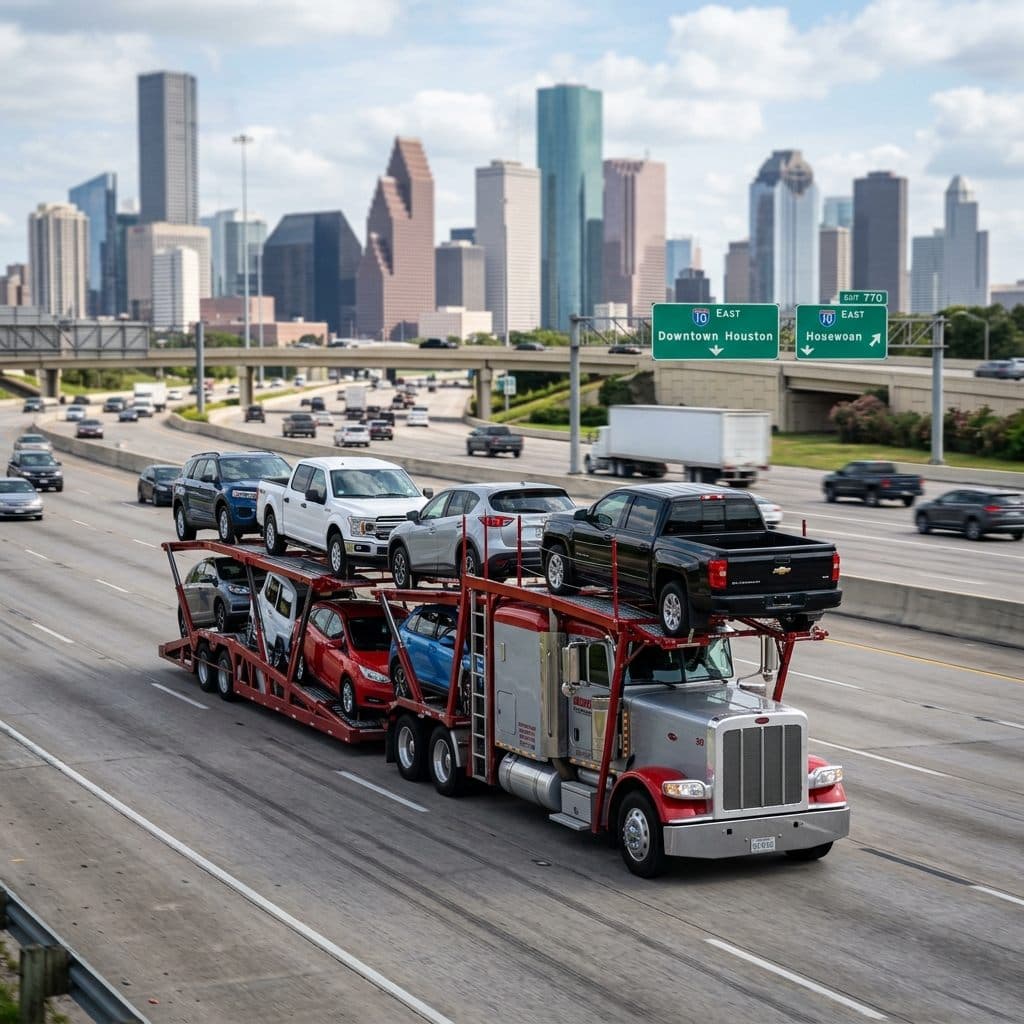
Houston to Honolulu is one of the stronger routes we coordinate from the South-Central United States. The overland leg runs 3 to 5 days to Long Beach via I-10, carrier availability from the Houston metro is among the best in Texas, and the total door-to-port timeline is more predictable from a Houston address than from most other major Southern cities. That said, there are a few things about this route that catch Houston customers off guard, and this guide covers all of them. This guide covers everything specific to shipping a car from Houston to Hawaii, including the I-10 corridor routing, why Houston carrier availability is tighter than Dallas despite the geography, how the Houston Ship Channel area affects pickup scheduling, and the full all-in cost from a Houston address.
How the Houston to Honolulu Route Works
Every vehicle shipping from Houston to Honolulu travels via two legs. The first leg is overland, where a licensed carrier picks up your vehicle in the Houston metro area and transports it to the Port of Long Beach in California. The second leg is ocean freight, where your vehicle loads onto an enclosed Matson Roll-on/Roll-off vessel at Long Beach and crosses the Pacific to Honolulu's Sand Island terminal. Houston routes through Long Beach, not Oakland. Oakland serves Northern California, Oregon, and Washington origins. Carriers from Houston travel I-10 west through San Antonio, El Paso, Tucson, and into Southern California. The route is direct and well-serviced. Houston to Long Beach via I-10 is approximately 1,550 miles, which is actually shorter than Dallas to Long Beach via I-20. Customers who look at a map and assume Houston is farther from the West Coast than Dallas are consistently surprised by this. The I-10 southern routing is more direct than the I-20 corridor from Dallas. The Long Beach port has a height clearance of 7 feet and a width clearance of 7 feet 2 inches. If your vehicle has a roof rack, cargo carrier, or extended mirrors, measure before booking. Our team confirms clearance on every booking call. Once your vehicle clears terminal intake at Long Beach, it loads onto the Matson vessel for the ocean crossing. Matson's enclosed RoRo vessels protect your vehicle from saltwater and weather for the entire Pacific transit. Your vehicle drives on at Long Beach and drives off in Honolulu. No open decks, no containers, no weather exposure during the crossing.
Total Transit Time: Houston to Honolulu
Plan for 17 to 21 days total from Houston door to Honolulu port pickup. That breaks down as follows: 3 to 5 days for the overland carrier leg from Houston to Long Beach, 1 to 2 days for port intake and vessel loading, and 12 to 14 days for ocean transit to Honolulu. After the vessel docks at Sand Island, allow 1 to 2 business days for agricultural inspection clearance before your vehicle is ready for pickup. The 3-to-5 day overland estimate applies to standard door-to-port pickups from the Houston metro area. Customers in The Woodlands, Sugar Land, Katy, or Pearland are all within the metro window. Customers further out, in Beaumont, Galveston, Victoria, or Corpus Christi, should add 1 to 2 days for carrier routing to their timeline. Our team asks for the exact address on every Texas booking because the overland estimate is address-specific, not city-specific. Standard booking lead time from Houston is 2 to 3 weeks minimum. During peak season from May through August, our team recommends 4 to 5 weeks. Houston summer adds carrier demand on the I-10 corridor on top of the standard seasonal volume pressure from military PCS moves and civilian relocations all hitting the same window.
Houston Carrier Availability and the I-10 Corridor
Houston has stronger carrier availability than most Texas cities, including Dallas, despite Dallas being geographically closer to Long Beach. The reason is the volume of commercial freight moving through Houston because of the energy industry and Gulf Coast shipping operations. Carriers stage in Houston between Gulf Coast and West Coast runs at a frequency that keeps the carrier pool deeper and pickup windows tighter than markets of comparable size elsewhere in Texas. Pickup windows from the Houston metro under normal conditions typically run 1 to 2 days from dispatch. Dallas runs 2 to 3 days. For customers choosing between the two for a Houston-area move, this is a meaningful difference when timing a pickup to a specific Matson sailing. Our team accounts for this when building your booking timeline and will tell you which sailing is realistic based on your specific zip code, not a generic Texas estimate. Where the Houston carrier picture gets more complicated is in the Ship Channel area. Customers with pickups in Pasadena, Deer Park, La Porte, or anywhere along the industrial corridor east of downtown face different access conditions than customers in residential areas. Heavy commercial truck traffic in that corridor, combined with loading zone restrictions around industrial facilities, can add a half day to a full day to carrier dispatch windows. Our team asks about this specifically for any Houston address that sounds like it might be near the Ship Channel. A pickup in Deer Park and a pickup in the Galleria are not the same scheduling problem.
What Your Vehicle Needs Before Leaving Houston
Vehicle preparation for Hawaii shipping is enforced at two checkpoints: the Long Beach terminal intake and Hawaii's agricultural inspection at Sand Island in Honolulu. Houston vehicles face a specific undercarriage concern that customers from other Texas cities do not always share. The Gulf Coast humidity combined with the flat terrain means Houston vehicles accumulate organic debris, mud, and biological material in wheel wells and undercarriage at a higher rate than vehicles from drier Central or West Texas climates. This material triggers holds at Hawaii ag inspection. A thorough undercarriage wash at a self-service car wash before carrier pickup takes 15 minutes and costs under $15. A port cleaning at Sand Island after a failed agricultural inspection costs $200 to $400 and delays vehicle release by 1 to 3 business days. Our team raises this specifically for Houston area customers whose vehicles have been driven in flooding, construction zones, or on unpaved roads in the greater Houston area, where mud and organic debris accumulate faster than average. The full preparation checklist before your carrier arrives in Houston: fuel above one-eighth tank and below one-quarter tank, vehicle completely empty, exterior, interior, and undercarriage clean, fully operational, photograph the vehicle before carrier arrives. Electric vehicles and plug-in hybrids are not accepted on any route. Non-running vehicles are not accepted. No exceptions on either.
Cost to Ship a Car from Houston to Hawaii
Port-to-port shipping from Long Beach Port to Honolulu starts at $1,680 with K’AI self-service: $1,580 in ocean freight plus the $100 booking fee. Door-to-port from Houston starts at $2,780 with K’AI, including ocean freight, mainland transport and the $300 booking fee. This is a city-level starting estimate; your final quote depends on your pickup address, vehicle and transport choice. Standard booking fees are $150 port-to-port and $500 for door service. The booking fee is included in the quoted total. Neighbor-island routes receive a separate quote.
Military PCS Moves from Houston and Texas Installations
Texas has a substantial military presence that generates PCS moves to Hawaii. The most active for Houston-area shipments are Joint Base San Antonio, which includes Lackland Air Force Base, Randolph Air Force Base, and Fort Sam Houston, as well as Naval Air Station Corpus Christi and the various reserve and guard installations around the Houston metro itself. Fort Cavazos, formerly Fort Hood, near Killeen also generates moves that route through Houston carriers. PCS customers shipping from Texas installations follow the same I-10 route and timeline as civilian shippers, but documentation and scheduling requirements are different and the consequences of a missed sailing are higher when reporting dates are fixed. When PCS orders change, and they do sometimes with under two weeks notice, our team re-books the next available sailing, adjusts the deposit, and gets the vehicle back on schedule.
Picking Up Your Vehicle in Honolulu
After the Matson vessel docks at Sand Island in Honolulu, your vehicle goes through the Hawaii Department of Agriculture biosecurity inspection before it is released. Inspectors check for insects, soil, seeds, and organic debris, particularly on the undercarriage and in the wheel wells. Vehicles that pass are available for pickup at the Sand Island terminal at 1411 Sand Island Parkway, Monday through Friday, 8 AM to 4 PM HST. Bring your government-issued photo ID and your booking confirmation. No additional documents are required to pick up a vehicle shipping to Hawaii. Documents are only required when shipping from Hawaii back to the mainland. Our team sends confirmation when the vessel departs Long Beach and again when it arrives in Honolulu. You will know exactly when your vehicle is ready before you make the trip to the terminal. Ready to get your Houston shipment on the calendar? Call our team directly at (808) 378-7540, Monday through Friday, 8 AM to 6 PM HST. Your deposit is applied toward your shipment total.