Why Many People Ship Car To Hawaii Instead Of Buying One In Hawaii
Many people relocating to Hawaii are surprised to learn that shipping their car is often more practical than buying one on the islands. The assumption before arrival is frequently that selling the mainland vehicle and purchasing a replacement locally will be the simpler path, but most new residents who actually go through the process of comparing Hawaii car prices with the cost to ship car to Hawaii discover that the calculation is far less favorable to local purchase than they expected.
Hawaii’s vehicle market is a small, geographically isolated inventory that serves a population of roughly 1.4 million people on islands with no road connection to the mainland supply chain, and those structural features drive local vehicle prices significantly higher than comparable mainland markets while simultaneously limiting the selection available at any given time.
Shipping vehicle to Hawaii preserves something equally important beyond the financial calculation: continuity with a vehicle the owner already knows. A car that has been maintained on a known service history, that fits the owner’s specific needs, and that has no hidden problems represents a known quantity in a way that a locally purchased used vehicle, bought in a market with limited inventory and pricing pressure in the seller’s favor, cannot match. For military families on PCS orders, for professionals relocating for work, and for anyone moving to Hawaii with a vehicle they depend on daily, car shipping to Hawaii is frequently the decision that makes the most practical and financial sense once all the variables are honestly assessed.
This guide explains why shipping a car to Hawaii instead of buying locally is the right choice for many new residents, compares Hawaii car prices with the typical cost to ship car to Hawaii, walks through how to ship a car to Hawaii step by step, covers Hawaii car registration requirements after arrival, and explains how to find the best Hawaii car shipping companies for your relocation. For those ready to begin the process, Car Shipping Hawaii is a Matson-certified specialist that makes Hawaii auto transport straightforward from booking through port pickup.
Why Many People Choose Car Shipping to Hawaii
The decision to ship a car to Hawaii rather than buy locally is driven by a combination of financial, practical, and psychological factors that converge to make car shipping to Hawaii the more rational choice for a significant majority of people who take the time to research both options before committing.
Familiarity and reliability: a vehicle the owner has maintained and driven for years is a known quantity. Its service history, its quirks, its actual mechanical condition, and its fit with the owner’s daily driving needs are all understood. A vehicle purchased in Hawaii’s used car market, by contrast, is an unknown whose actual condition, maintenance history, and undisclosed problems are assessed only at a single point of sale under time pressure from a relocation timeline. The peace of mind that comes with shipping a well-maintained, trusted vehicle is a genuine practical benefit that does not appear in a simple cost comparison but matters significantly in the quality of the ownership experience after arrival.
Limited inventory on the islands: Hawaii’s vehicle market is small relative to any mainland metropolitan area of comparable economic activity. The selection of specific makes, models, trim levels, and color combinations available at any given time is a fraction of what a buyer in Los Angeles, Chicago, or Dallas would find, and buyers with specific requirements, including those who need a vehicle with particular safety ratings, towing capacity, fuel efficiency, or accessibility features, may simply not be able to find what they need locally at a reasonable price or timeline.
Avoiding the new resident premium: Hawaii car dealers and private sellers are aware that new residents arriving from the mainland are often under time pressure to acquire transportation quickly, and that awareness shows up in pricing. New residents who have not yet established local networks, do not know the local market comparables, and need transportation within days of arrival are at a structural disadvantage in price negotiations that mainland buyers with less urgency do not face. Shipping a vehicle to Hawaii eliminates this vulnerability entirely.
Preserving equity in a paid-off or financed vehicle: selling a vehicle on the mainland before relocation and repurchasing in Hawaii means realizing the mainland sale value and then paying the Hawaii premium for a replacement, which is a guaranteed loss on the value differential in most cases. Owners of paid-off vehicles, or of vehicles with favorable financing terms that would not be available on a Hawaii purchase, have a specific financial interest in shipping rather than replacing.
Hawaii Car Prices Compared to Mainland US
Hawaii car prices are consistently higher than comparable mainland prices for both new and used vehicles, and understanding why helps buyers appreciate why the shipping versus buying calculation so often favors shipping for new residents who already own a suitable mainland vehicle.
Every vehicle sold in Hawaii, whether purchased from a dealer or imported by a private party, arrives on the islands by ocean freight. New vehicles shipped from mainland assembly plants or from international factories to Hawaii dealerships travel via the same Matson ocean freight vessels that consumer car shippers use, and the cost of that ocean transport is embedded in the dealer’s landed cost and reflected in the retail price. This baseline transportation premium applies to every vehicle in Hawaii’s new car inventory, making Hawaii car prices structurally higher than mainland prices for the same model before any other cost factors are considered.
For used vehicles, the Hawaii car price premium is compounded by the limited local supply. Vehicles that enter Hawaii’s used car market come from one of three sources: new vehicles that are sold locally and eventually resold as used, mainland used vehicles imported by dealers or private parties, or vehicles shipped to Hawaii by relocating individuals who eventually sell after arrival.
The total pool of used vehicles circulating in Hawaii at any given time is small relative to any comparable mainland population center, and that scarcity drives used car prices above mainland comparable levels by margins that vary by make, model, and demand segment but are consistently meaningful. Buyers who need a practical, well-maintained used vehicle in a popular make and model may find Hawaii prices fifteen to thirty percent above comparable mainland asking prices, and popular trucks and SUVs suited to Hawaii’s terrain can command even larger premiums.
Read Also:
Moving to Hawaii? Here Is What to Know Before You Ship Your Car
Cost to Ship a Car to Hawaii
The cost to ship car to Hawaii for a standard passenger vehicle on Port-to-Port RoRo ocean freight service from California ports typically ranges from approximately one thousand to sixteen hundred dollars, representing the single most important number in the shipping versus buying comparison. When that shipping cost is compared directly against the Hawaii car price premium that new residents face on a local purchase, the economics of shipping frequently favor the ship option by a margin that surprises people who assumed local purchase would be cheaper.
The shipping car to Hawaii cost varies based on several factors that every owner should understand before requesting quotes from Hawaii car shipping companies. Vehicle size is the primary driver of rate variation within the standard RoRo service tier, with full-size pickup trucks and large SUVs incurring surcharges relative to the standard sedan and compact SUV base rate. Departure port affects both price and timeline, with California ports generally offering the most competitive rates and the most frequent sailing options. Seasonal demand, particularly during the May through August military PCS peak season, affects both pricing and availability.
- Port-to-Port RoRo service: the most cost-effective Hawaii car shipping option for owners who can self-deliver their vehicle to the West Coast departure port. The owner drives the vehicle to the Long Beach, Oakland, or Tacoma terminal during the port acceptance window, checks it in with the carrier, and claims it at the Port of Honolulu after the vessel crossing. For West Coast residents, this is consistently the cheapest way to ship a car to Hawaii.
- Door-to-Port service: a carrier driver picks up the vehicle from the owner’s mainland location and delivers it to the departure port, adding an inland transport cost that varies by distance from the pickup location to the nearest departure port. Inland US customers from Colorado, Texas, the Midwest, or the Southeast typically use Door-to-Port because self-delivering to a West Coast port is impractical from their location.
- Enclosed container shipping: vehicles that require maximum protection during the ocean crossing, including classic cars, high-value vehicles, and modified builds, can be shipped in enclosed steel containers rather than on the open vehicle deck. Container shipping costs more than standard RoRo but provides complete weather and debris protection for vehicles where that additional protection justifies the premium.
How to Ship a Car to Hawaii
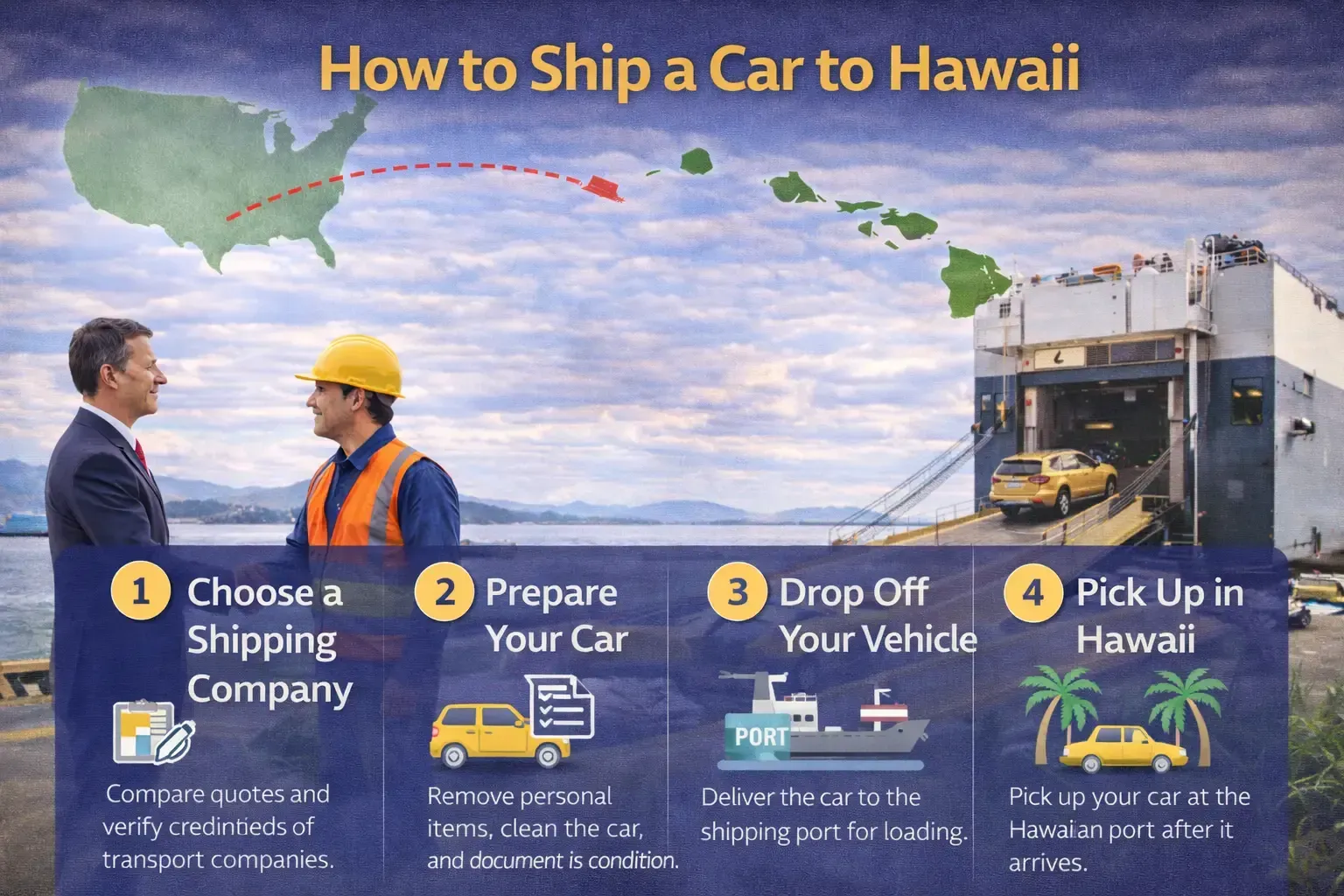
Step 1 — Choose a Reliable Hawaii Car Shipping Company
Select a carrier that specializes in Hawaii auto transport, holds valid FMCSA registration, and has a direct working relationship with Matson Navigation Company for weekly sailing access. Hawaii car shipping companies that operate as brokers for both the land transport and the ocean freight legs have less control over timeline coordination than carriers with direct Matson access. Read independent customer reviews and confirm cargo insurance coverage terms before booking.
Step 2 — Request a Shipping Quote
Contact your shortlisted Hawaii car shipping companies with accurate vehicle information including year, make, model, overall dimensions, current location, and target shipping dates. Request an itemized quote that separates ocean freight, port handling fees, and any inland transport or fuel surcharge components. Compare quotes on an all-in basis with consistent service tier and vehicle specifications across providers.
Step 3 — Prepare the Vehicle for Transport
Wash the vehicle thoroughly inside and out, remove all personal belongings from the interior and trunk, reduce the fuel level to one quarter tank or less, and confirm the vehicle is in operable condition for drive-on port loading. Take timestamped photographs of all exterior surfaces, the interior, and the odometer before handing the vehicle over to the carrier or driving it to the port. Gather the vehicle title, current registration, government-issued photo ID, and lien authorization letter if the vehicle is financed.
Step 4 — Deliver the Vehicle to the Departure Port
For Port-to-Port service, drive the vehicle to the departure terminal during the acceptance window for the target sailing and complete the bill of lading condition inspection. For Door-to-Port service, the carrier driver arrives on the scheduled pickup date and performs the condition inspection at your location. Review every notation on the bill of lading and confirm that all pre-existing damage is accurately documented before signing.
Step 5 — Pick Up the Vehicle at the Hawaii Port
Your shipping coordinator will notify you when the vessel arrives and your vehicle is available for pickup at the Port of Honolulu. Bring the original bill of lading and valid government-issued photo ID to the Matson terminal at Sand Island. Inspect the vehicle thoroughly before signing the delivery receipt and note any transport-related damage before leaving the port.
Read Also:
What to Prepare Before Shipping Your Vehicle: A Complete Checklist
Cheapest Way to Ship a Car to Hawaii
For new residents comparing the total cost of shipping versus buying, identifying the cheapest way to ship a car to Hawaii is an important input into the financial analysis. Several strategies reduce the shipping car to Hawaii cost without compromising service reliability or vehicle safety.
- Self-deliver to the Port-to-Port terminal: for West Coast residents who can drive or arrange delivery of their vehicle to Long Beach, Oakland, or Tacoma, Port-to-Port service eliminates the inland transport carrier cost entirely and is almost always the cheapest way to ship a car to Hawaii available for customers with departure port access.
- Book at least two to three weeks in advance: Hawaii car shipping companies that have vessel space secured in advance can offer standard pricing, while last-minute bookings during high-demand periods may require premium rates to access available sailing dates. Planning ahead is particularly important during the summer PCS military season when Hawaii auto transport demand peaks.
- Ship during off-peak months: fall and winter months, particularly September through February, typically offer more competitive Hawaii car shipping rates and more flexible scheduling than the summer peak season. New residents with flexibility in their relocation timeline can sometimes realize meaningful savings by adjusting their shipping date by a few weeks.
- Get at least three itemized quotes: comparing quotes from multiple Hawaii car shipping companies on an equivalent service, route, and vehicle specification basis identifies genuine cost variation across carriers. Price differences that reflect different service scope or departure port assumptions rather than actual cost variation can mislead single-quote buyers.
- Avoid unnecessary add-ons: supplemental insurance, expedited handling, and storage options add cost to the base shipment. Evaluate each additional service against your vehicle’s specific risk profile and your actual timeline needs before accepting add-ons as part of the package.
Auto Transport to Hawaii and Shipping Logistics
Understanding how auto transport to Hawaii works demystifies the process for first-time shippers and helps new residents plan their relocation timeline around the ocean shipping schedule that governs vehicle delivery dates.
Hawaii car shipping operates on Matson Navigation Company’s weekly sailing schedule from three West Coast departure ports: Long Beach in Southern California, Oakland in Northern California, and Tacoma in Washington State. Vessels depart on a consistent weekly schedule from each port, and vehicles that are accepted into the port terminal before the acceptance window closes board that week’s sailing. Vehicles that arrive after the acceptance window closes wait for the following week’s departure, which is why timing the vehicle’s arrival at the port relative to the weekly sailing schedule is the most important coordination variable in the entire process.
The standard shipping method for Hawaii car shipping is RoRo, or Roll-on, Roll-off, where vehicles are driven onto the vessel’s vehicle deck under their own power by port staff and driven off at the destination port after arrival. RoRo is the most cost-effective ocean freight option and is appropriate for all operable standard passenger vehicles. The ocean crossing from West Coast ports to Honolulu takes approximately five to seven days, and port processing after vessel arrival typically adds one to two business days before the vehicle is available for owner pickup. The total door-to-Honolulu-pickup timeline for West Coast Door-to-Port customers is typically ten to sixteen days from carrier pickup, making shipping vehicle to Hawaii a well-defined and predictable process when booked with adequate lead time.
Hawaii Car Registration Requirements for New Residents
After the vehicle arrives in Hawaii and is claimed at the port, new residents must complete the Hawaii car registration requirements before the vehicle can be legally operated on public roads. Understanding these requirements in advance prevents the delays and surprises that catch unprepared new arrivals off guard.
Hawaii Revised Statutes require new residents to register their vehicles within thirty days of establishing residency in the state. The registration process is administered at the county level, with Honolulu County handling Oahu registrations, Maui County handling Maui and neighboring islands, Hawaii County handling the Big Island, and Kauai County handling Kauai. Each county’s motor vehicle registration office requires the completed registration application, the vehicle title, proof of valid auto insurance from a Hawaii-licensed insurer, government-issued photo ID, and a current safety inspection certificate issued by a licensed Hawaii inspection station.
The Hawaii vehicle safety inspection is the step that most new residents underestimate in their post-arrival planning. A valid safety inspection certificate from another state does not satisfy Hawaii’s requirement, and every vehicle shipped to Hawaii must pass a fresh Hawaii safety inspection before it can be registered. The inspection covers exterior lighting, brakes, tires, windshield and glass, seat belts, steering, horn, and wipers, and must be performed at a county-licensed inspection station. The Hawaii car inspection cost for a standard passenger vehicle is typically fifteen to twenty-five dollars, and the inspection itself takes fifteen to thirty minutes when no deficiencies are found. Addressing obvious lighting, tire, and brake issues before the inspection appointment maximizes the chance of passing on the first visit.
- Documents required for Hawaii vehicle registration: vehicle title (or lien authorization if financed), government-issued photo ID, current mainland registration (for VIN cross-reference), proof of Hawaii auto insurance from a Hawaii-admitted insurer, and the original safety inspection certificate from a licensed Hawaii station.
- Timeline for completing registration: the thirty-day residency registration window combined with the safety inspection requirement means new residents should schedule their Hawaii vehicle inspection within the first week after port pickup to allow time for any repairs needed before a re-inspection and the registration office processing time.
Choosing Reliable Hawaii Car Shipping Companies
The Hawaii car shipping market includes specialized carriers that focus exclusively on Hawaii auto transport and general auto transport brokers who add Hawaii routes to a mainland-focused business. For a shipment as logistically specific as mainland to Hawaii ocean freight, the difference between these two types of providers matters significantly for timeline reliability, documentation support, and the overall shipping experience.
- Direct Matson access: the most important differentiator among Hawaii car shipping companies is whether the provider has a direct working relationship with Matson Navigation Company, the primary ocean freight carrier for Hawaii vehicle transport. Direct access means reliable sailing schedule information, confirmed vessel space, and the ability to coordinate inland delivery timing with port acceptance windows accurately. Brokers operating without direct Matson relationships introduce an additional coordination layer that reduces control over the timing variables that determine whether a vehicle makes its target sailing.
- FMCSA registration: confirm the carrier’s USDOT number and operating authority through the FMCSA SAFER database before booking. All legitimate auto transport companies operating in the United States are required to maintain valid FMCSA registration and can provide their USDOT number on request.
- Vehicle shipping insurance: confirm the carrier’s cargo liability insurance coverage limit and deductible before booking. For vehicles whose replacement value exceeds the carrier’s standard liability limit, supplemental marine cargo insurance is available and should be evaluated. Ask specifically whether the carrier’s cargo coverage applies during the ocean transit portion of the journey as well as the land transport legs.
- Transparent itemized pricing: the best Hawaii car shipping companies provide quotes that clearly separate ocean freight cost, port handling fees, and inland transport components so that the all-in price is fully transparent before booking. Quotes that bundle all costs without itemization or that require additional fee disclosure at the time of booking create budget uncertainty that itemized quotes avoid.
- Customer reviews specific to Hawaii routes: read independent reviews that specifically reference Hawaii auto transport experiences rather than mainland-only shipments. Hawaii-specific reviews reveal how the carrier handles the ocean freight coordination, Honolulu port pickup support, and communication quality across the multi-week shipping timeline that mainland-only reviews do not assess.
How Car Shipping Hawaii Helps Customers Transport Vehicles
Car Shipping Hawaii is a veteran-owned vehicle shipping company based in Honolulu and a Matson-certified shipping specialist with direct access to weekly sailings from Long Beach, Oakland, and Tacoma. We specialize exclusively in Hawaii auto transport, which means every aspect of our operation is built around the specific logistics, documentation requirements, and customer needs of the mainland to Hawaii vehicle shipping process.
For new residents evaluating whether to ship their vehicle or purchase locally, we offer honest guidance on both the shipping process and the post-arrival registration and inspection requirements, so customers arrive in Hawaii with realistic expectations for every step from port pickup through their first drive on Oahu or the Neighbor Islands. Our transport coordinators walk customers through the preparation steps that ensure their vehicle clears port acceptance without delays and arrives at the Honolulu terminal ready for immediate pickup.
We offer Port-to-Port service for customers who can self-deliver to the West Coast departure port, Door-to-Port service for customers anywhere in the continental US, enclosed transport for classic and high-value vehicles, and dedicated military shipping services for active duty families receiving PCS orders to Hawaii. Every vehicle we ship receives a thorough photographic condition inspection at pickup, and our team is available Monday through Friday, 8AM to 6PM HST, to answer questions throughout the process.
Final Thoughts on Shipping a Car to Hawaii Instead of Buying Locally
- Hawaii car prices are consistently higher than comparable mainland prices for both new and used vehicles because every car sold in Hawaii arrives by ocean freight and because the island’s small, geographically isolated vehicle market lacks the competitive inventory pressure that keeps mainland prices lower. New residents who compare the actual cost to ship car to Hawaii against the Hawaii price premium on a local replacement vehicle frequently find that shipping is the more financially sound decision.
- Car shipping to Hawaii for a standard passenger vehicle onPort-to-Port RoRo servicefrom California typically costs one thousand to sixteen hundred dollars all in, a figure that in most cases represents a fraction of the price differential between mainland and Hawaii vehicle values and that preserves the owner’s equity in a vehicle with known maintenance history and specific-fit features.
- The cheapest way to ship a car to Hawaii is Port-to-Port self-delivery to the West Coast departure port, booked at least two to three weeks in advance, during off-peak fall or winter months if the relocation timeline permits, and priced by comparing itemized all-in quotes from multiple Hawaii car shipping companies with consistent service scope and vehicle specifications.
- Hawaii car registration requirements mandate a fresh Hawaii vehicle safety inspection and county registration within thirty days of establishing residency, with documents including the vehicle title, Hawaii auto insurance proof, government photo ID, and the safety inspection certificate required for registration approval, making post-arrival planning as important as the shipping process itself.
- The best Hawaii car shipping companies combine direct Matson carrier access, FMCSA registration, transparent itemized pricing, cargo insurance with confirmed terms, and proactive milestone communications that keep customers informed from mainland departure through Honolulu port pickup, ensuring the shipping vehicle to Hawaii process runs on schedule and without avoidable surprises.
Moving to Hawaii? Car Shipping Hawaii helps transport your vehicle safely so you can focus on settling into island life.
Camilo Jaime
Camilo Jaime is an experienced Hawaii auto transport specialist with deep knowledge in car shipping logistics, Matson vessel coordination, port protocols, military PCS relocations, and a wide range of ocean freight services. He understands the challenges that come with shipping vehicles to and from the Hawaiian islands for families, service members, and businesses alike.
Through his blogs at Car Shipping Hawaii, Camilo shares practical shipping tips, cost-saving advice, and insights drawn from real coordination experience. His goal is to help readers make confident decisions about Hawaii vehicle transport and learn straightforward ways to navigate port requirements, sailing schedules, and service options. With a clear and honest writing style, Camilo focuses on real solutions that make the car shipping process simple, stress-free, and affordable for every customer.
You Might Also Like