Here's a riddle that stumps almost everyone who moves to the islands: Hawaii has Interstate highways, but they don't connect to any other state. They can't. There's an ocean in the way. So why are they called Interstates, and why did one of them become the single most expensive Interstate ever built in America? The answer is stranger, and more Hawaiian, than you'd think.
Yes, Hawaii Really Has Interstates
Hawaii has three Interstate highways (H-1, H-2, and H-3) plus a shorter spur, H-201. The H stands exactly for what you'd hope: Hawaii. And here's the first surprise for newcomers: every one of them is on Oahu. Not a single Interstate mile exists on Maui, Kauai, or the Big Island. So no, the Interstates don't connect the islands to each other any more than they connect Hawaii to California.
So How Can an Island Have an "Interstate"?
The trick is in the full, mostly-forgotten name of the system: the National System of Interstate and Defense Highways. That word, defense, is the whole answer. The Interstate program was always as much about moving the military as it was about moving families.
When Hawaii became a state in 1959, federal law still limited Interstate funding to the "continental United States." So President Eisenhower signed the Hawaii Omnibus Act on July 12, 1960, which struck that limit and let Interstate construction money flow to the islands. Three routes were designated just weeks later, on August 29, 1960. National defense was one of the official criteria used to justify them, and it shows in where they go. Hawaii's Interstates link Pearl Harbor, Hickam, Schofield Barracks, and the Marine Corps base at Kaneohe. They don't connect states; they connect bases.
H-3: The Most Expensive Interstate Ever Built
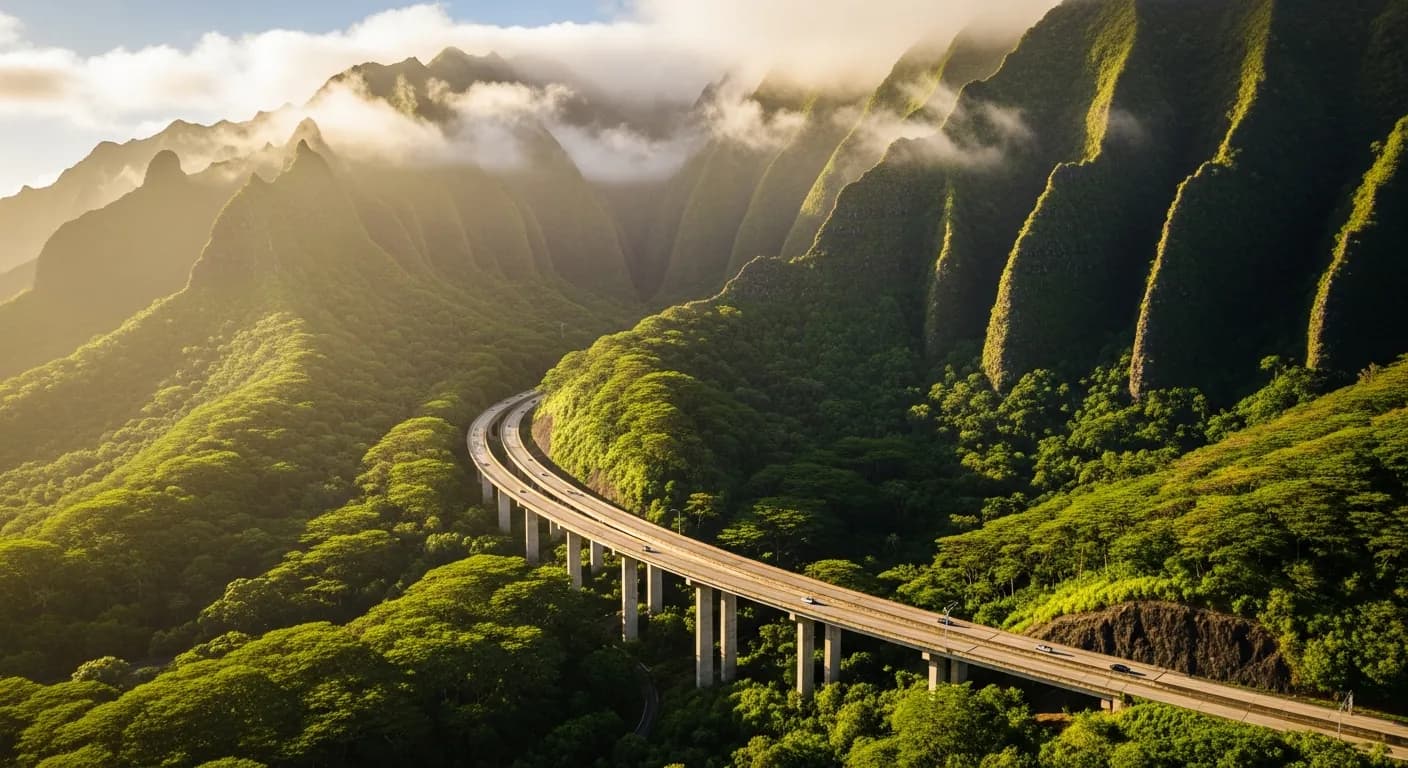
If you only drive one Hawaiian Interstate, make it H-3, a jaw-dropping ribbon of elevated concrete that threads through the Koolau mountains from Pearl Harbor to Marine Corps Base Hawaii on the windward side.
It also holds a national record nobody wanted to pay for: on a cost-per-mile basis, H-3 is the most expensive Interstate ever built. The final bill came to about $1.3 billion, roughly $80 million per mile, and it took around 37 years from its 1960 authorization to its opening on December 12, 1997. Construction didn't even begin in earnest until the late 1980s, after Senator Daniel Inouye secured a 1986 exemption from most environmental laws to break years of legal gridlock.
The Controversy Beneath the Concrete
H-3 was fought over for decades, and not only in court. The original route through Moanalua Valley was abandoned after a foundation formed to protect sacred Native Hawaiian sites there, including a petroglyph stone known as Pohaku ka Luahine. The highway was rerouted, but many Native Hawaiian practitioners consider the land it ultimately crossed culturally significant too, and some describe the road as cursed.
The environmental toll was real as well. Repeated lawsuits over habitat and endangered species were only ended by that congressional exemption, and after construction the Oahu alauahio, a small native honeycreeper, disappeared from the Halawa area. H-3 is beautiful. It is also a monument to what it cost, in dollars and otherwise, to build a freeway across a Hawaiian mountain range.
What This Means Once Your Car Arrives
For a new resident, the practical takeaway is simple: once your vehicle is on-island, these are the roads you'll actually live on, H-1 through Honolulu traffic and H-3 over the mountains to the windward side. You don't need a car that can cross state lines. You need your own car here, on Oahu, ready to go.
That's the part we handle. If you're planning the move, here's how shipping your car to Hawaii works and what it costs, so the car you already know is waiting for you when you land, instead of a rental counter and a long line.
Frequently Asked Questions
Why does Hawaii have Interstate highways? Because the Interstate system was formally the National System of Interstate and Defense Highways, and Hawaii's routes were funded and justified largely for national defense, connecting major military installations on Oahu. The 1960 Hawaii Omnibus Act made the islands eligible for Interstate funding.
What does the H stand for? Hawaii. The state's Interstates are numbered H-1, H-2, H-3, and H-201.
How many Interstates does Hawaii have? Three main routes (H-1, H-2, H-3) plus the H-201 spur, all of them on Oahu.
Why is H-3 so famous? It's the most expensive Interstate ever built on a cost-per-mile basis, about $1.3 billion or roughly $80 million per mile, and it took some 37 years and a special environmental exemption to complete.
Do Hawaii's Interstates connect the islands? No. Every Interstate mile in Hawaii is on Oahu; there's no highway link between islands. Moving a car between islands is done by ocean barge, not by road.